

8 Types of Microscope Light Sources for Stereo Microscope
Illumination is one of the key components of microscopic imaging. Different samples and different observation purposes require different lighting techniques. Choosing the appropriate light source is essential to obtain clear images.
Cold Light Source and Thermal Light Source
From the perspective of light sources, they can be commonly classified into cold light sources and hot light sources.
Cold light sources convert almost all the energy into visible light, with very little light of other wavelengths. Therefore, cold light sources are more energy-efficient and environmentally friendly. LED is typical cold light sources. The spectral wavelength range emitted by LED is very narrow. LED light sources have a long lifespan, low energy consumption, low cost, and can be turned on and off instantly. Therefore, LED is becoming currently the mainstream lighting sources for microscopes.
Thermal light source is an illuminant that emits light by utilizing thermal energy, where 80%-90% of the energy is converted into heat energy, and about 10% of the energy is converted into visible light. In addition to emitting visible light, thermal light sources also emit a large amount of infrared light. Common examples include incandescent lamps and halogen lamps. Halogen lamps emit light by heating the filament, so they are thermal light sources. If the sample is sensitive to temperature and you want to reduce damage, halogen lamps can be illuminated through an optical fiber cable. The optical fiber cable facilitates heat dissipation, significantly reducing heat energy. Halogen lamps can provide high-brightness and wide-bandwidth illumination.
Optical fibers are fibers made of glass or plastic, which are light-conducting tools that utilize the principle of total internal reflection of light in these fibers for transmission. The fine fibers are encapsulated in the plastic sheath, allowing them to bend without breaking. The optical fibers have small volume, light weight, low raw material cost and low transmission loss.
8 Types of Microscope Light Source of Stereo Microscope
In terms of the types of illuminators, there are various illuminators that are suitable for different usage scenarios.
Point light
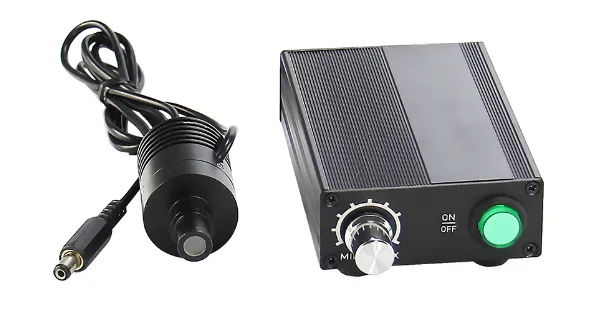
The point light is small in size, lightweight and space-saving. It can achieve high brightness in a small area. It is generally used for small-scale or local lighting. When combined with a telecentric lens tube, it can also be used as parallel light illumination.
Goose neck lamp
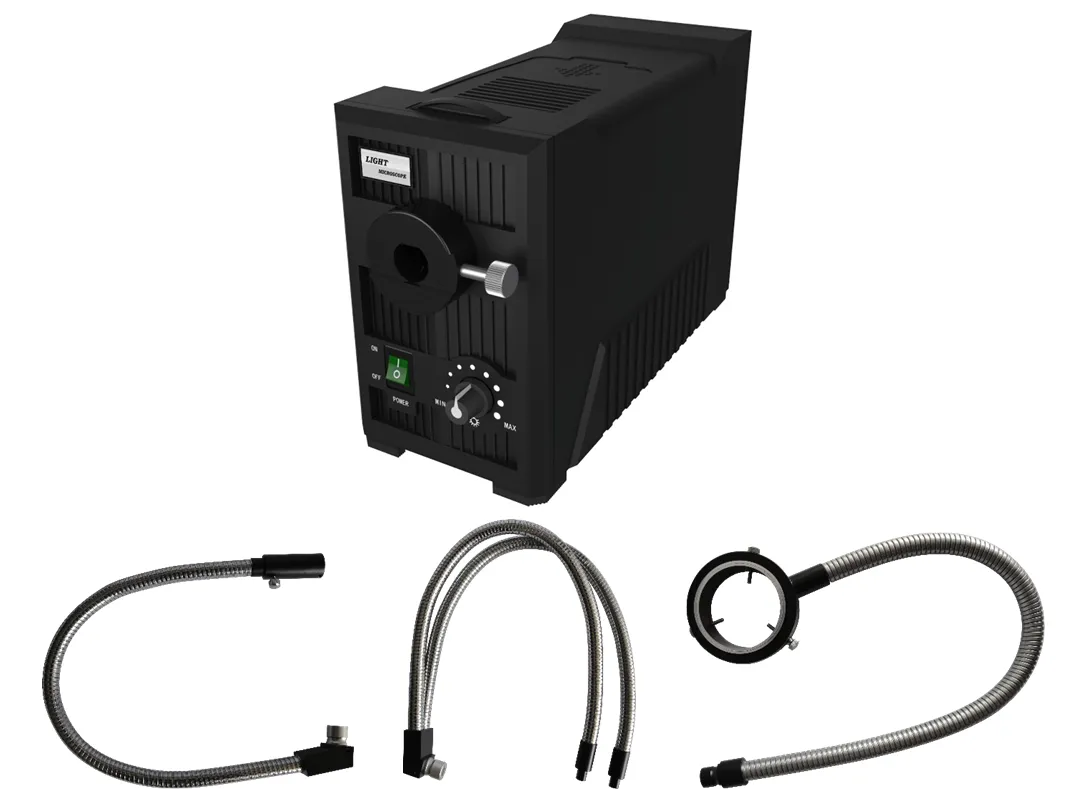
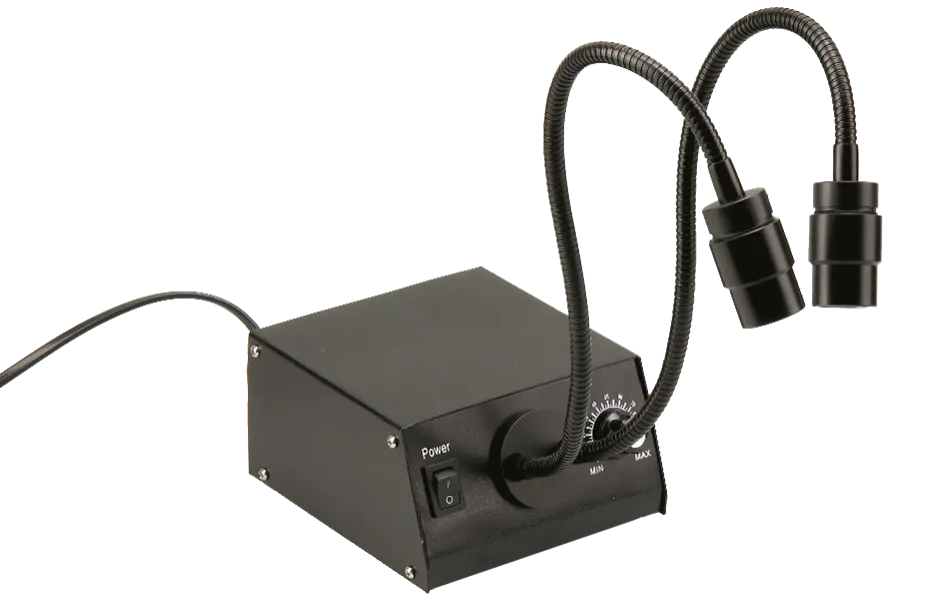
The external halogen or LED light source uses optical fibers to provide intense and focused illumination, or the LEDs located at the front end of the goose neck provides a uniform light spot. The advantage of the goose neck lamp is that the angle can be adjusted. The goose neck is flexible and can be adjusted to any angle to achieve the best illumination. The light of the goose neck lamp is relatively focused and high intensity, which is suitable for local high-intensity focused lighting. Common applications of goose neck lamps include industrial inspection, forensic work, high-magnification imaging, etc.
Ring light
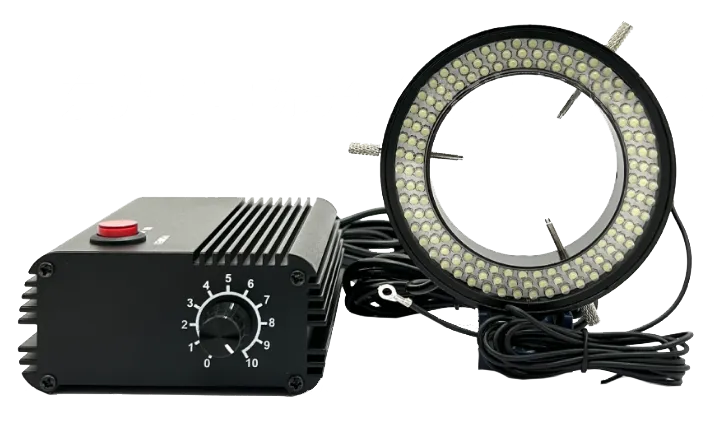
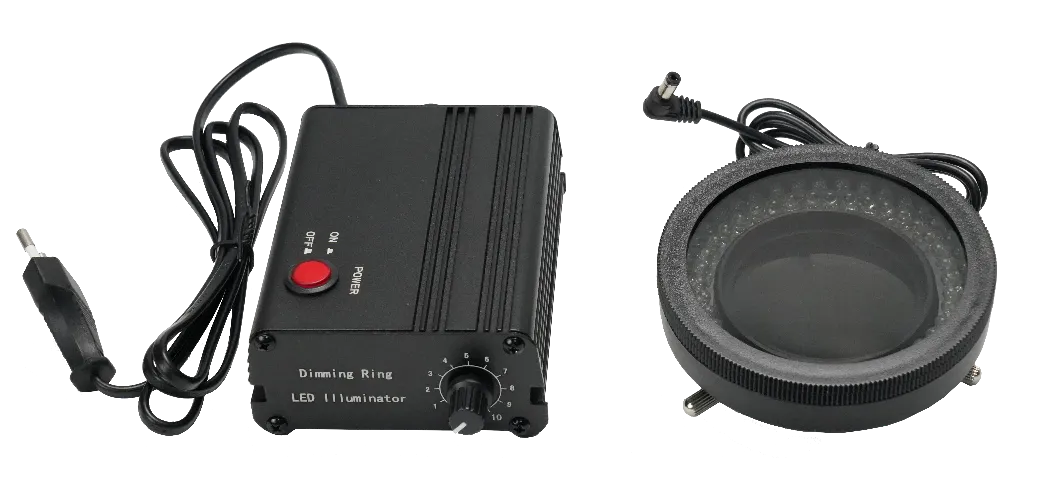
The ring light is one of the most common LED light sources, providing basic lighting. The ring light emits light evenly and is easy to install. The lighting effect and characteristics vary with the angle of illumination and the installation height of the ring light. High-angle ring lights can achieve uniform epi-illumination, while low-angle ring light directly illuminate samples within a very small angle to show details of edges and surface of the sample. Usually, it is difficult to detect the flaws of the edges or surface of an object with standard direct lighting. But with low-angle ring light, due to the almost parallel direction of the light and the surface, various changes in the surface height will alter the optical path, thereby highlighting the changes in surface concavity and convexity.
Polarizing ring light
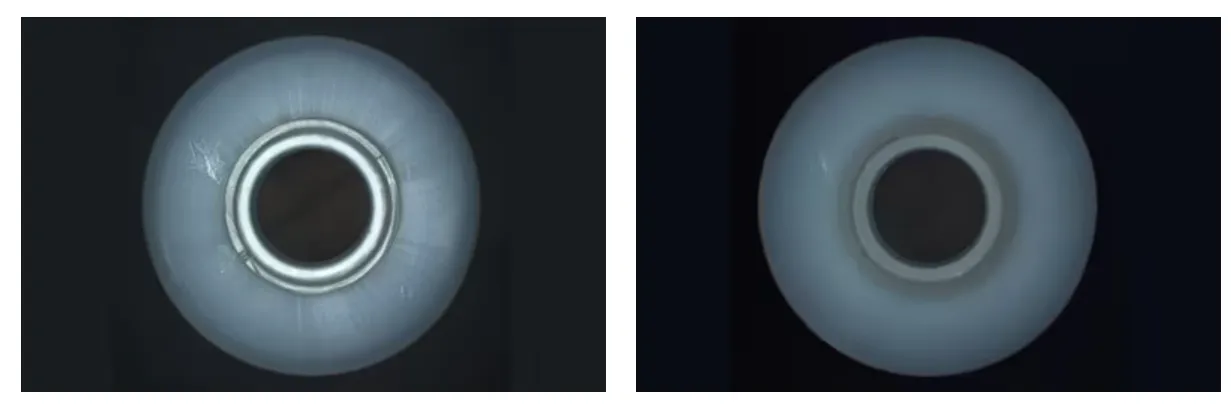
Left: Standard Ring Light, Right: Polarizing Ring Light
The polarizing ring light is a special type of light source that combines a ring light with polarization technology. It can effectively reduce specular reflection and glare, to enhance contrast and highlight details. By adjusting the angle and brightness, it can adapt to different needs and is suitable for observing objects with high reflectivity or complex surfaces. Common applications of polarizing ring lights include defect detection of scratches and cracks on reflective materials such as glass and metal surfaces, inspection of the welding quality of electronic components like PCBs and chips, and detection of transparent materials such as plastic films and glass bottles.
Coaxial illumination
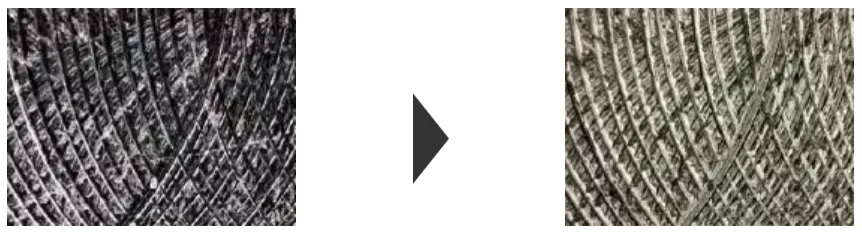
Left: Ring Light, Right: Coaxial Illumination
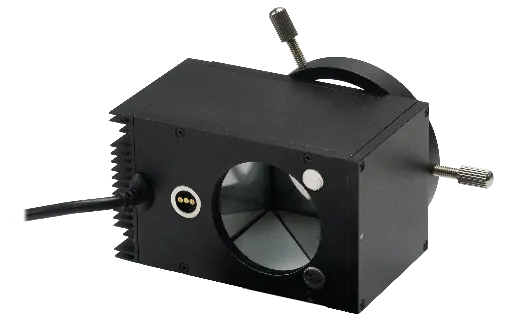
The light emitted by the coaxial illuminator directed by a semi-transmissive and semi-reflective mirror to change its direction, so that the light is parallel to the optical axis of the lens and shines onto the surface of the object. The reflected light from the object will then pass through the semi-transmissive and semi-reflective mirror again and enter the lens for imaging. Since the illumination light path is coaxial with the imaging light path, the shadows caused by the tiny depressions and protrusions on the object surface are minimized, resulting in a weak sense of 3D. Coaxial illumination can provide very uniform frontal illumination, eliminate interference from specular reflection, effectively suppress stray reflected light from the environment or other sources, and only allow the reflection light perpendicular to the surface to enter the lens, thereby clearly presenting the details on the surface, such as texture, scratches, stains, engraved characters, etc. However, because the coaxial light undergoes twice semi-transmissive and semi-reflective processes from emission to reception by the lens, there will be a significant loss in brightness.
Common applications of coaxial illumination include detecting scratches, pits, foreign objects and dirt on smooth surfaces, reading characters, barcodes and QR codes on highly reflective surfaces, detecting defects on mirror, coating, LCD screen and wafer surfaces, measuring the size and position of precision components, etc.
Back light
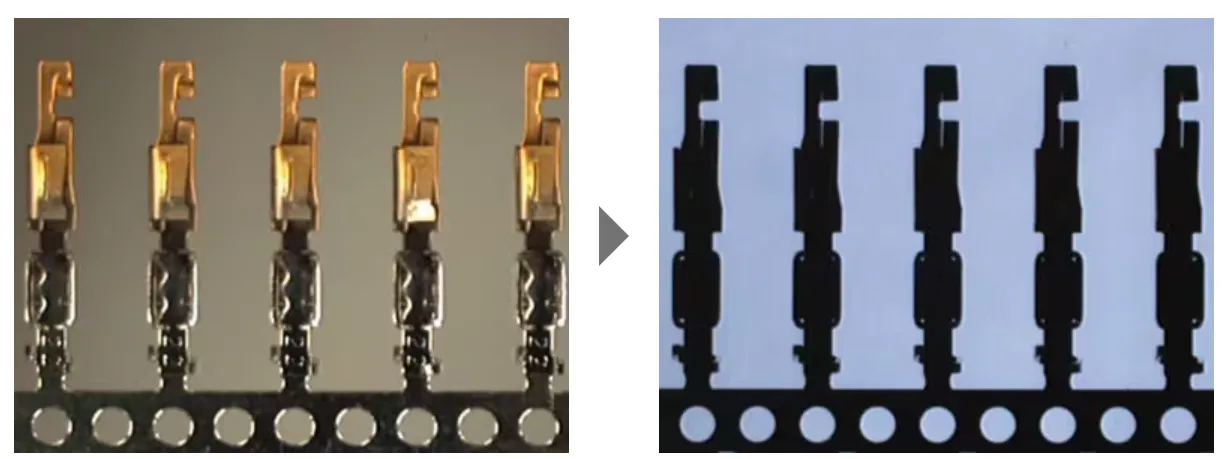
Left: Standard Illumination, Right: Back light
Typically, the illuminator is located between the lens and the sample. The lens obtains surface information through the reflected light from the surface of the samples. However, back light is different. It works like transmission light. The sample is placed between the back light and the lens. Information is obtained by the sample blocking the light. If the sample is opaque, a dark projection will be produced by back light, forming a high-contrast and clear outline for observation. This avoids the situation where the contrast between the object and the background is low due to factors such as the color or surface processing of the sample when using traditional lighting. If the sample is transparent, due to the differences in density of different materials, the sample absorbs and transmits light differently, which can also generate a certain degree of contrast for easier observation.
Bar illuminator
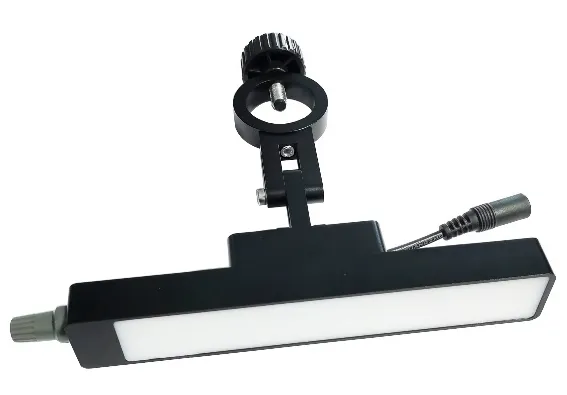
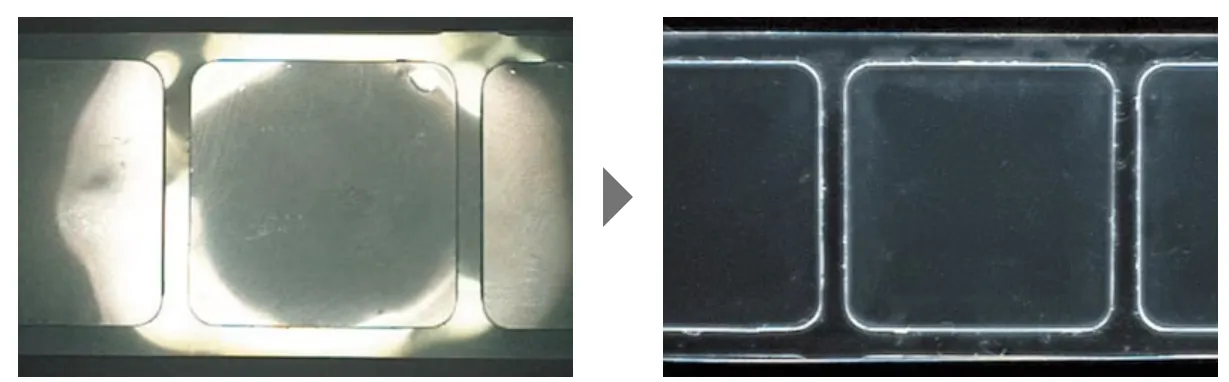
Left: Ring Light, Right: Bar Illuminator
The bar illuminator can uniformly illuminate a long-sized area. The main advantages of the bar illuminator are high light intensity and uniform illumination. The bar illuminator can reduce shadows and reflections, which is more conducive to observing the details of the sample. At the same time, the bar illuminator can also be installed as oblique illumination, using diffuse reflection illumination to avoid specular reflection that may cause halo.
Fluorescent light source
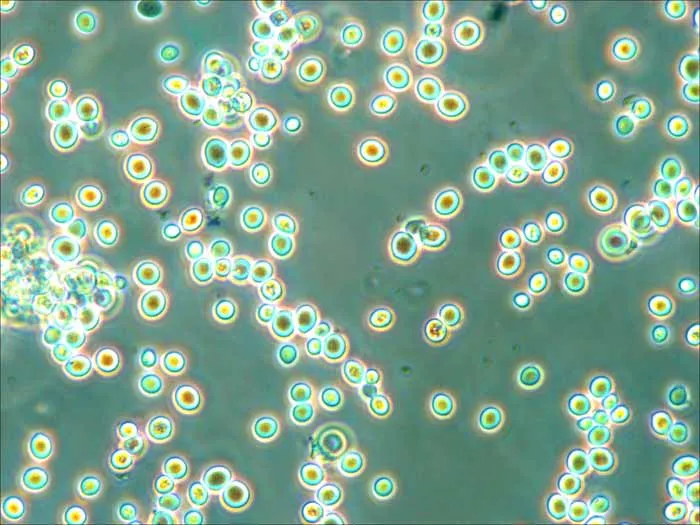
Fluorescent light source is used for fluorescence observation. Common fluorescent light sources include mercury lamps and LED lamps.
Mercury lamp bulbs are made of quartz glass, with a spherical shape in the middle, filled with a certain amount of mercury inside. During working, they discharge between two electrodes, causing mercury to evaporate, and the internal pressure of the bulb rapidly increases. When all the mercury has evaporated, a pressure of 50-70 standard atmospheres can be achieved, and this process generally takes 5-15 minutes. Mercury lamp is wide-bandwidth white light sources, capable of providing a series of wavelengths from ultraviolet to near-infrared. The peak has high excitation energy. Although it ensures a bright fluorescence signal, the light toxicity is very high. It is suitable for fixing samples or imaging of weak fluorescence. The lifespan of mercury lamps is relatively short, generally within 1000 hours, and the cost of the mercury bulbs is high.
LED lamps can be switched on and off in milliseconds, reducing the exposure time of the samples and extending the service life of the samples. At the same time, the attenuation of the LED light source is rapid and precise, which can greatly reduce the light toxicity in long-term live cell experiments, and is suitable for live cell imaging. Compared with mercury light sources, the excitation spectrum of LED light sources is narrower, so the imaging noise is lower, and multiple different wavelength LEDs can be used for multi-color fluorescence imaging applications. LED light sources have a long lifespan, low energy consumption, and low cost.
Comparison of 3 Common Types of Microscope Light Sources for Stereo Microscope
The ring light, coaxial illumination and back light are the three most commonly used types of light source for stereo microscopes. Each has its own unique characteristics and is suitable for different applications.
|
Ring Light |
Coaxial Illuminator |
Back Light |
|
|
Light Direction |
Circularly surrounding the lens, directly shine on the sample |
Coaxial with the optical axis of the lens |
From behind the sample to the lens |
|
Shadow Effect |
Surrounding shadow |
Almost no shadow |
Shadow of sample outline |
|
Characteristics |
Provide uniform frontal lighting with moderate 3D effect |
Eliminate surface reflection interference and reveal surface details and textures |
Transmitted illumination, displaying clear outlines of samples |
|
Sample Surface |
It can only show a certain degree of surface features, not as fine as those with coaxial illumination |
Smooth and reflective surfaces can also show details |
It can show the surface of transparent samples, while opaque samples mainly show the outline and do not show the surface features |
|
Advantage |
Versatile, easy to install, with a 3D appearance |
Eliminate glare, achieve uniform lighting, suitable for high-reflective surfaces |
Sharp outline, high dimensional accuracy |
|
Shortage |
It may cause central shadows, and smooth surfaces may have reflective halos |
High cost, significant loss of brightness and weak image three-dimensionality |
The front features of the opaque sample cannot be seen |
|
Application |
General frontal illumination, appearance inspection |
Detection of defects on smooth surfaces, imaging of high-reflective samples |
Dimension measurement, contour detection, positioning, observation of transparent or semi-transparent objects |
BestScope offers a wide variety of light sources to meet your different lighting and observation requirements, including point lights, ring lights, coaxial illuminators, bar illuminators, back lights, etc.