

Scientific Microscope Camera Buying Guide: Resolution, Sensitivity and Frame Rate
When exploring the microscopic world, the microscope camera is a good tool to capture images and record videos, to observe samples and share findings. No matter you use a microscope to do biological research, industrial inspections, material analysis or teaching, there are a variety of microscope cameras available on the market to meet your needs. There is some information as a buying guideline for choosing a suitable microscope camera quickly for your observation to get high-quality images.
What influence the quality of images?
The quality of images under the microscope captured by the microscope camera is influenced by many parameters, among which the key ones include resolution, sensitivity and frame rate of the camera. These 3 parameters are interrelated and mutually restricted. According to different needs, prioritize different parameters when choosing a camera.
Resolution
Resolution is a key parameter that describes the clarity of an image. It is usually expressed in pixels. A pixel is the smallest unit that makes up an image. It can be imagined as a tiny square with only one color. Each pixel has a specific position and color value. A certain number of pixels make up an image. For instance, a 2 mega-pixels (2MP) image means it has 2 million pixels, and the resolution of the image can be 1920*1080, length 1920 pixels and width 1080 pixels, as known as 1080P.

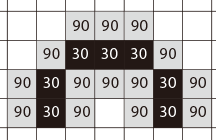
The size of each pixel can be expressed in terms of pixel size. When the image size remains unchanged, the more pixels a picture contains, that is, the smaller the pixel size is, and the higher its resolution will be, so the richer the details and color information the image can carry.
However, it is not that the higher resolution of a microscope camera is, the better image quality you will have. The resolution of the microscope images is limited by the optical system of the microscope itself, such as the numerical aperture of the objective lens. According to the Nyquist-Shannon sampling theorem, the camera pixel size should be less than half of the minimum resolvable structure size of the microscope to keep high-quality images, which is the optimal pixel size. Although the smaller pixel size can result in clearer image, there will be no significant improvement in image quality if it is less than half of the optimal pixel size. For instance, if the objective lens with NA=1.4 is used and the optical resolution limit is approximately 200nm (the optical resolution limit is about d=0.61* emission wavelength /NA value), the optimal pixel size in this situation should be 6.5μm, and a camera with a pixel size between 3.25μm and 6.5μm should be selected. At the same time, the resolution of the image you eventually see is also limited by the resolution of the display. For instance, a 1080P monitor can only display a maximum of 1080P images.
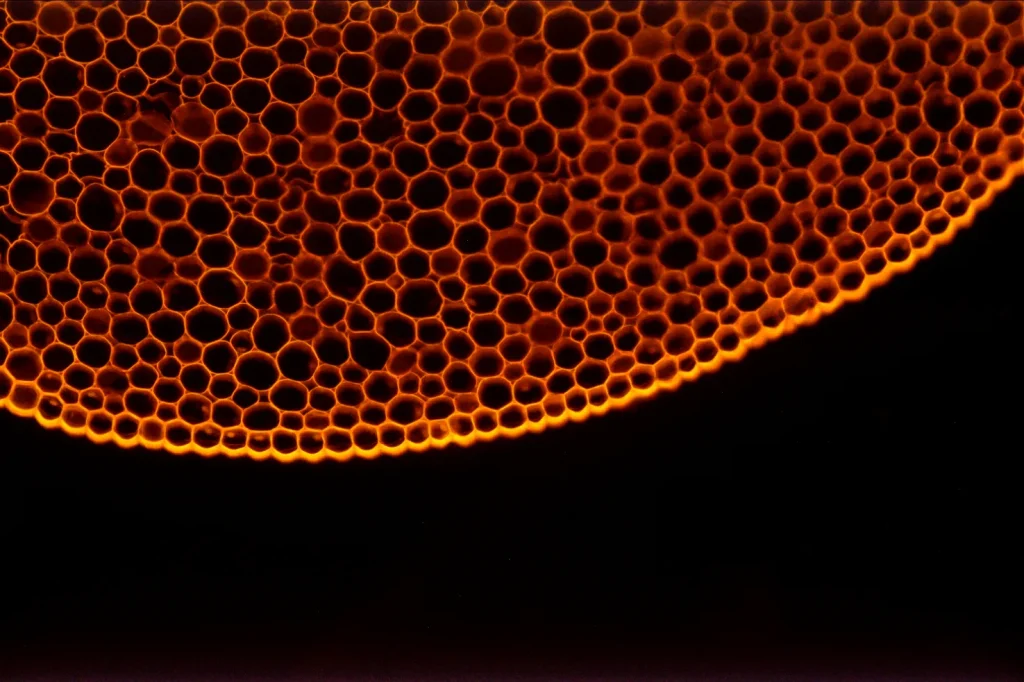
BUC5IA-2000M 20MP Resolution Cooled C-mount USB3.0 CMOS Microscope Camera
Generally speaking, a camera of 5MP to 10MP is sufficient for most microscopic observations. Common resolutions for HDMI microscope cameras, using with LCD screens, include 1080P (1920*1080, 2 million pixels) and 4K (3840*2560, 8 million pixels).
However, high resolution does not necessarily mean high image quality, as the improvement of resolution to some extent requires sacrificing the other parameters of the camera.
Sensitivity
The sensitivity of the camera describes how sensitive is the camera sensor to light.
Signal-to-noise ratio, SNR, is the ratio of the intensity of useful signals to the noise in a system. High SNR images is clear and shows effective information. The number of electrons converted from photons by the camera sensor is determined by the brightness of the sample or environment and the sensitivity of the camera. In bright environments or when observing bright samples, a high SNR is easy to achieve. However, for dark environments and low-light samples, sensitivity is crucial to get images with a high SNR. A microscope camera with high sensitivity can capture weak light and display details of the sample.
Sensitivity is determined by the pixel size and quantum efficiency of the camera. A larger pixel size can collect more photons and has higher sensitivity. But, as you know, a large pixel size will reduce the resolution.
Quantum efficiency, QE, refers to the percentage of incident photons that the image sensor can convert into electrons. For instance, if an image sensor has a QE of 75% and is exposed to 100 photons, it will be able to convert into 75 electrons. High-end image sensors can achieve a high QE of 95%. The wavelength of the detected light, the material of the sensor, and the structural design of the sensor can all affect quantum efficiency. In practical applications, quantum efficiency is not an important feature in all imaging applications. In sufficient light environment, such as bright field microscopic observation, increasing QE and sensitivity has almost no effect to the image quality. But in low-light imaging, the higher the QE of a camera, the higher its sensitivity. With high QE, even in low light or short exposure times, the camera can still captured clear images.
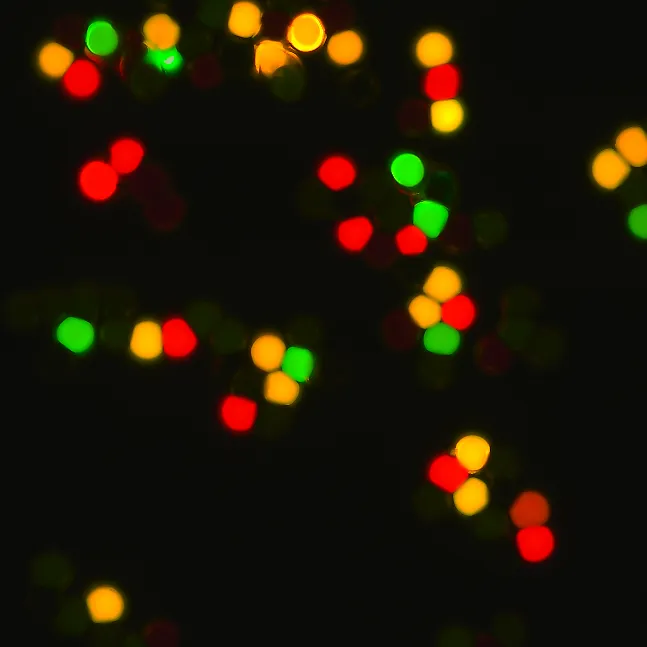
Therefore, if you use a fluorescence microscope with camera for fluorescent imaging, especially weak fluorescence, sensitivity should be the priority parameter to be considered and a camera with large pixel size and high QE should be chosen.
Frame rate
Frame rate refers to the number of complete images captured by a camera per second, determining the smoothness of the real-time image. If you want to observe dynamic samples in real time or record videos, you need to pay attention to the frame rate parameter of the camera. If the frame rate is low, the photos captured during the moving may be blurry and the video may have obvious stuttering. Generally, the minimum frame rate to avoid unsmooth video actions is 30FPS.
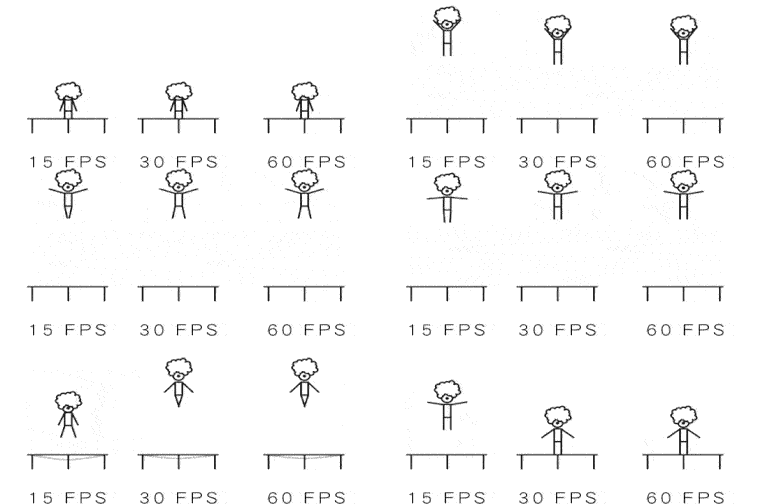
Frame rate is jointly influenced by readout speed of the sensor, interface bandwidth and exposure time.
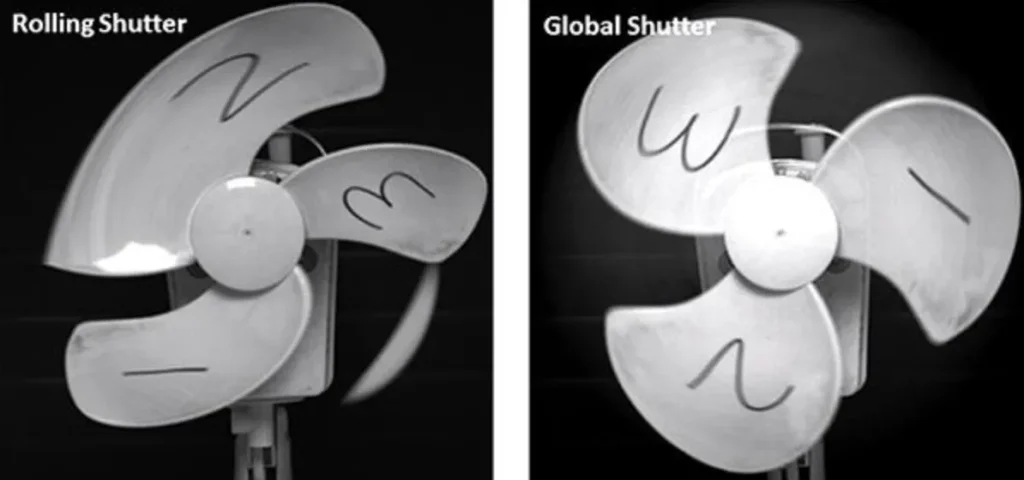
Rolling shutter mode and reducing pixels can improve the readout speed, increasing frame rate. The global shutter has a shorter exposure time, but its maximum frame rate may be lower than that of rolling shutter. Because rolling shutter usually work in overlapping mode, that is, each individual line of pixels finishes reading the previous frame but starts working on the next frame before the entire frame is completely completed. Rolling shutter can achieve higher frame rates, but when exposure is improper or the object moves too fast, phenomena such as partial exposure, skew and wobble may occur. This phenomenon that happens in roller shutter shooting is called the jelly effect. So, if you want to observe a rapidly moving sample, you should choose the global shutter or using global reset to avoid jelly effect. On the other hand, reducing pixels means high frame rate but low resolution. To avoid that, the ROI area function can be used, which only export the selected area of the image, ensuring the local pixels remain unchanged while reducing the number of output pixels, to increase the readout speed and thereby to enhance the frame rate.
High frame rate needs high-speed interface with large bandwidth, such as USB3.0 (480Mbps), GigE (1Gbps) and Camera Link (6Gbps).
Short exposure time can also increase the frame rate. But a shorter exposure time means fewer incident photons, thereby reducing the number of converted electrons and reducing the sensitivity. It is not suitable for use in low-light imaging.
How to choose the suitable microscope camera?
In conclusion, because resolution, sensitivity and frame rate are key parameters influence the quality of the image and these 3 parameters are interrelated and mutually restricted, you need to prioritize different parameters based on your needs in order to choose the appropriate camera.
For the observation of μm or nm level scale structures characterization, such as material surface analysis, metallographic inspection, semiconductor and wafer inspection, a microscope camera with high resolution and large sensor size should be chosen. Image stitching and measurement function can also help you in these applications.
BUC5F-830DC C-mount USB3.0 CMOS Microscope Camera
For fluorescence imaging, especially weak fluorescence, such as GFP labeling and multiple fluorescence labeling, you need high sensitivity microscope camera. sCMOS cameras with high QE are your ideal choice.
BUC6IA-400C Real-color Cooled FSI sCMOS Camera
BUC5IF- 700M-G TE-Cooling C-mount USB3.0/GigE COMS Camera
For dynamic sample imaging and recording, such as live cell observation, neural signal transmission and microfluidics research, a microscope camera with high frame rate and global shutter is ideal to avoid distortion during moving. A cooled camera is able for long exposure time and long-term recording.
BGCIA-1000M/580M Ultimate Sensitivity sCMOS Camera
BUC5ID- 420BM TE-Cooling C-mount USB3.0 CMOS Microscope Camera
Nowadays, some microscope cameras offer more than one output mode to meet the diverse needs, such as high dynamic range (HDR), high sensitivity and high speed. With different output parameters, one microscope camera can be satisfied to various observation situations and shooting needs by selecting corresponding modes.
BUC5IA-900M Cooled C-mount USB3.0 CMOS Microscope Camera
BUC5IA-2600M Cooled C-mount USB3.0 CMOS Microscope Camera
Choose a microscope camera of BestScope that suits your needs and start your microscopic journey!