

What Do Frame Rate, Pixel Size, and Dynamic Range Mean in Microscope Cameras?
Nowadays, more and more users of microscopes buy microscope cameras for catching images, recording videos, doing measurement and sharing data. There are various of technical terms and parameters about cameras that you may be unacquainted and feel confused when you choose and use the cameras.
Let’s begin with basic parameters, such as frame rate, pixel size and dynamic range, and then expand to know more technical terms to help you choose the appropriate microscope camera, be familiar with microscope cameras quickly and set the parameters or choose the appropriate mode for different applications.
What frame rate means in microscope cameras
Frame rate describes the speed of imaging, referring to the number of complete images captured by the camera per second, that is, FPS. If you want to observe dynamic samples in real time or record videos, you need to pay attention to the frame rate parameter of the camera. If the frame rate is low, the photos captured during the moving may be blurry and the video may have obvious stuttering. Generally, the minimum frame rate to avoid unsmooth video actions is 30FPS.
The microscope cameras with high frame rate have many applications, such as capturing brief dynamic processes in cells like protein binding, real-time observing and recording live cell movement process, etc. High-speed imaging can avoid motion artifacts to improve the accuracy of quantitative analysis. Also, quick imaging can reduce photobleaching to protect live cells and fluorescent labels.
Frame rate is jointly influenced by many factors.
Exposure Time
Exposure time is the time of the shutter from open to close. During this period, the sensor is exposed to the light. Exposure time influences the imaging speed directly. The shorter the exposure time is, the faster the imaging speed and the higher the frame rate. But shortening exposure time may reduce the signal that the sensor received, so that some weak light may not be received by the sensor and shown in the image. If shorten the exposure time, the number of incident photons that the sensor can receive decreases, reducing the number of electrons converted from photons, lowering the sensitivity. The sensitivity significantly affects the signal-to-noise ratio, SNR, of images in dim environment or with weak light samples. Images with high SNR can be clear and show more effective information. However, if you use the microscope with the camera in a bright environment or observe a bright sample, shortening the exposure tome can increase the frame rate without much sacrificing the image quality.

Sensor Size
Reducing the sensor size can fasten the imaging speed and increase the frame rate. The sensor size is a parameter that describes the size of the photosensitive sensor, usually expressing with the diagonal length. The actual physical size of the sensor is generally represented by the effective area. The smaller the sensor sizer is, the smaller the image size, the less data needed to be output, so the shorter transmission time per frame and the higher the frame rate. However, if the sensor size is reduced, the SNR, signal-to-noise ratio, will decrease because the amount of light signal that can be received by the photosensitive units will decrease, or the image resolution will decrease because the number of pixels. Therefore, some cameras have ROI, Region of Interest, function. When you need to get the image of a specific small area quickly, the ROI function can help you. With ROI function, only the selected area is imaged and output, increasing the readout speed and improving the frame rate while ensuring the local resolution remain unchanged.
Global Shutter & Rolling Shutter
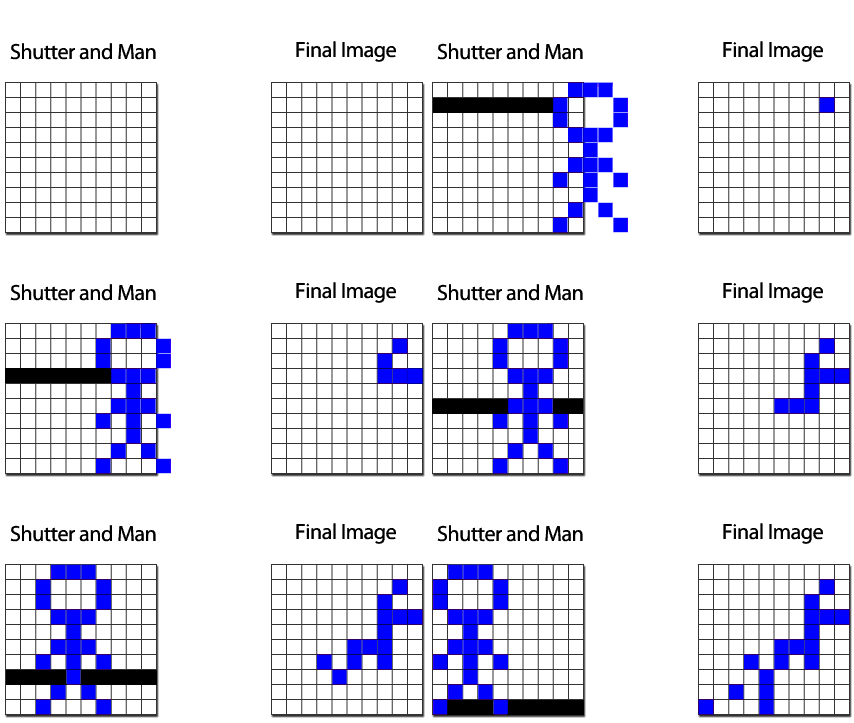
Apart from the readout speed of the sensor itself, the shutter mode can also affect the frame rate. The global shutter has a shorter exposure time, but its maximum frame rate may be lower than that of the rolling shutter. Because rolling shutter usually work in overlapping mode, that is, each individual line of pixels finishes reading the previous frame but starts working on the next frame before the entire frame is completely completed. Rolling shutter can achieve higher frame rates, but when exposure is improper or the object moves too fast, phenomena such as partial exposure, skew and wobble may occur. This phenomenon that happens in rolling shutter shooting is called the jelly effect. So, if you want to observe a rapidly moving sample, you should choose the global shutter or using global reset to avoid jelly effect.
Output Interface
The bandwidth of the output interface also affects the frame rate. The wider the bandwidth, the faster the transmission speed, the higher the frame rate. Commonly fast transmission interfaces include the USB3.2 Gen2 with a max bandwidth of 10Gbps, 10GigE with a max bandwidth of 10Gbps, and Camera Link with a max bandwidth of 6Gbps.
Why pixel size matters in microscope cameras
A pixel is the smallest unit that constitutes an image. It refers to the tiny, independent photosensitive unit of the sensor. Each pixel has a specific position and color value. The size of each pixel can be expressed in terms of pixel size.
Pixel size is a fixed physical property and is determined by the sensor itself. Pixel size can affect the resolution and the sensitivity of the microscope camera. You can choose the pixel size according to your needs.
Resolution
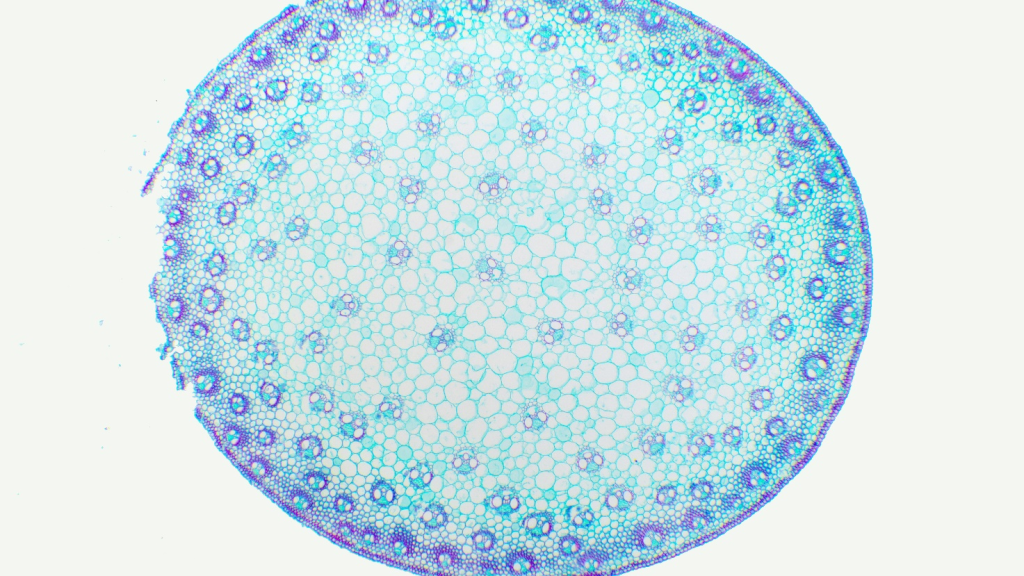
When the image size remains unchanged, the more pixels a picture contains, the smaller the pixel size, and the higher its resolution, so the richer the detail and color information the image can carry.
If you need a microscope camera for the applications with sufficient illumination and requiring high precision, such as material analysis, metallographic observation, semiconductor measurement, observation of nm or μm structural characterization, etc. a microscope camera with a relatively smaller pixel size should be chosen.
Sensitivity
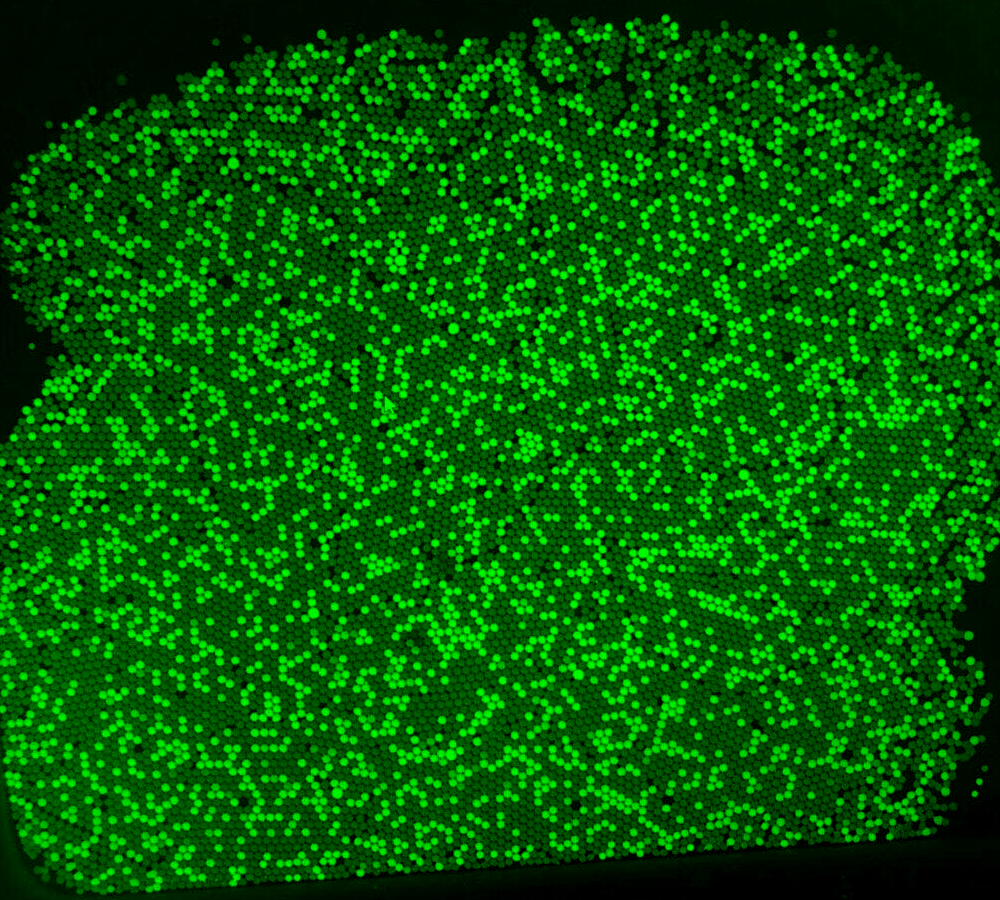
The sensitivity of the camera describes how sensitive is the camera sensor to light. The camera with high sensitivity can capture weak light and display details, to get high SNR images. Signal-to-noise, SNR is the ratio of the intensity of useful signals to the noise in a system. High SNR image is clear and shows effective information.
A larger pixel size means that each photosensitive unit can collect more photons, resulting in higher sensitivity. Quantum efficiency, QE, referring to the percentage of incident photons that the photosensitive sensor can convert into electrons, can also influence the sensitivity. Higher QE is, higher sensitivity of the sensor. High sensitivity cameras are suitable for observing weak fluorescence or in dim environments, for instance, GFP labeling and multiple fluorescence labeling. In such cases, a microscope camera with a relatively larger pixel size and high QE should be chosen.
What dynamic range means in microscope cameras
Dynamic range refers to the ratio of the highest and lowest signals that a sensor can simultaneously record. In images produced by sensors with low dynamic range, bright signals may be white or overexposed, while shadow areas may be black due to insufficient exposure, failing to show details of some area. Dynamic range can be understood as the ratio of full well capacity to noise.
Full Well Capacity
Full well capacity is the maximum amount of detection light signal that each photosensitive unit can contain, referring to the number of electrons that can be placed in the storage space of each pixel and accurately readout physically. It is subjected to the physical structure limitation of the photosensitive unit of the camera sensor. If a pixel has received too many photons and reached saturation, it will no longer carry out photoelectric conversion. As a result, the gray level cannot be accurately recorded. The photons exceeding the full well capacity may overflow to the adjacent pixels in certain cases, causing ‘Blooming’ and generating artifacts.
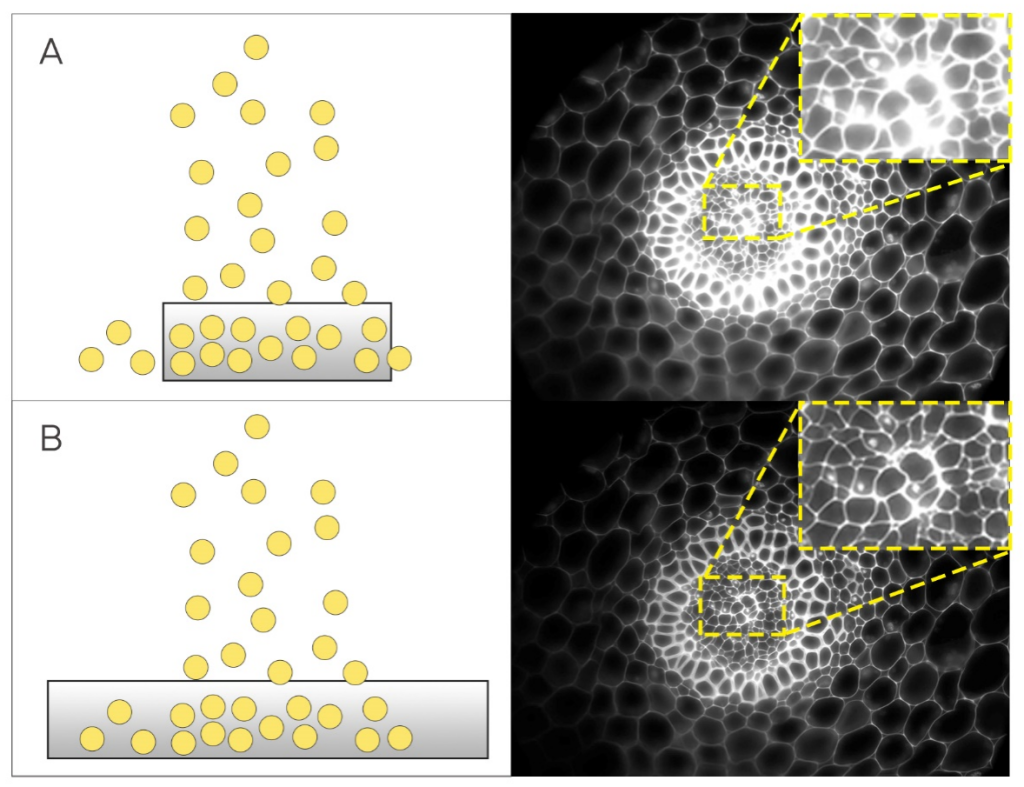
A higher full well capacity allows longer exposure time or higher light levels to detect weak light signals, while high signals will not reach saturation to get high dynamic range images.
High full well capacity will reduce frame rate and increase readout noise. If it only works in low light environment without high light signals, or high-speed imaging is a more requirement, then full well capacity and dynamic range are not what you need to be given special consideration.
Bit Depth
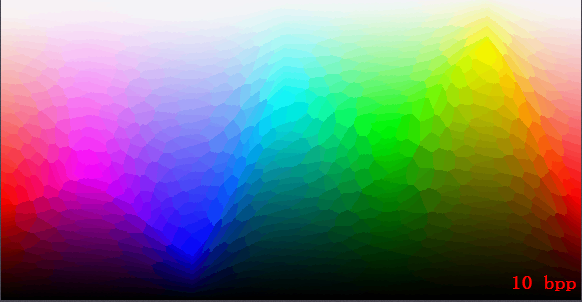
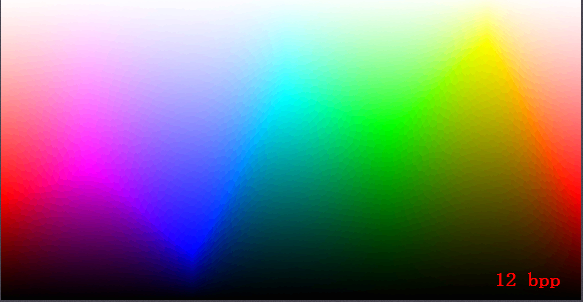
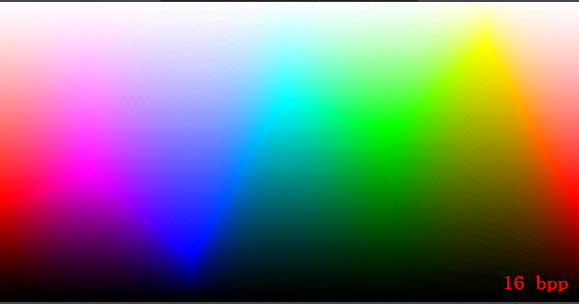
For digital images, computers record the color or grayscale information of each pixel with binary digits. The bit is the unit of measurement and bit depth represents how many colors or grayscales the image can display. For example, 8bit means that each photosensitive unit can show 28, that is, 256 colors or grayscales. The more color or grayscales that can be shown, the more details the image can display. So, the lager the bit depth, the better the dynamic range that can be presented. However, dynamic range is a physical characteristic of the photosensitive senser, while bit depth is a characteristic of the photoelectric converter, and they are not directly related.


HDR
HDR, High Dynamic Range, is a technology that enables high contrast images to display as more details as possible. When bright areas under strong light and dark areas such as shadows coexist in one image, the image captured by ordinary camera may have the bright areas overexposed appearing white while the dark areas due to insufficient exposure appearing black. Neither overexposure nor insufficient exposure can show the details. HDR function is combining multiple images with different exposures with the software to get one single image that has details in both the high-light areas and the shadow areas.
Choose the suitable microscope camera
With the above guide, choose the suitable microscope camera of Bestscope to meet your needs.
High-speed camera with USB3.2 Gen2:
BUC5K-830C USB3.2 Gen2 Digital Microscope Camera
Large pixel size camera for low light environment and fluorescence imaging:
BUC5IF- 700M TE-Cooling C-mount USB3.0/GigE COMS Digital Microscope Camera
Camera with HDR function: