
How to Parfocal Microscope Objectives?
When using microscopes, good parfocality can avoid frequent focusing during the switch of objectives. Frequent focusing will reduce the efficiency of the observation and also cause eye fatigue. So how can we solve the problem of not parfocality?
Parfocal Distance
The parfocal distance refers to the distance between the positioning surface of the objective when it is focused on the target and the surface of the observed object. It is the distance between the installation positioning surface of the objective and the surface of the sample. It is a mechanical dimension. The parfocal distance should match the focal length of the tube lens.
The core function of the parfocal distance is to ensure that when different magnification objectives are used, the focus position of the sample remains basically consistent, without the need for significant focusing adjustments, significantly reducing the time for focusing adjusting operations, thereby improving operational efficiency.
The parfocal distance can affect the imaging quality and operational convenience of the microscope. It also protects the objectives from damage caused by direct contact with the observed object or the stage. The design of the parfocal distance also takes into account the thickness of the cover glass. The standard thickness of cover glass is generally 0.17mm.
According to different brands and different optical systems, the common standard values of parfocal distance are 39mm, 45mm, 60mm and 95mm. Generally, the parfocal distance of the objectives of the same brand is the same. Mixing objectives with different parfocal distances can cause focus shift. The parfocal distance in the JIS standard is 39mm. For finite optical system, the international standard for parfocal distance is 45mm, so finite objectives from different brands can theoretically be mixed. With the popularization of infinite optical system, to match the focal length of the tube lens, a parfocal distance of 60mm has emerged. The industrial standard for the parfocal distance of objectives used in the high-end industrial field is generally 95mm.
The parfocal distance of the objectives not only determines the size of the space in the objectives for integrating lens elements, but also affects the structure and ergonomic design of the entire microscope system. Therefore, the selection of the parfocal distance needs to be balanced among optical performance, mechanical structure, ergonomics and cost. Although a longer parfocal distance is beneficial for designing long working distance objectives and provides more space for integrating complex optical elements, the longer parfocal distance also results in a longer distance between the exit pupil and the subsequent optical elements, larger objective diameter, more severe correction problems, higher costs and generally higher alignment sensitivity of the objective. Additionally, when the parfocal distance is increased, the viewing head of an upright microscope and the stage of an inverted microscope inevitably have to rise along with the increase in the parfocal distance, causing an adverse effect on the ergonomic design. Therefore, most brands adopt a focal distance of 45mm.
How to Parfocal Microscope Objectives
Usually, the objectives of microscopes are designed with standardized parfocal distances when they are manufactured. However, due to the possible slight differences between individual microscopes and objectives, if you find that you need to adjust focus frequently during the switch of objectives, you can try to adjust the parfocal distance of the objectives. Generally speaking, it is best to have professionals from the dealer complete this task. But if you have some mechanical operation and maintenance experience, you can also make the adjustment yourself.
Please note that different microscopes may have different methods and standards for adjusting the parfocal distance. Therefore, before adjusting the parfocal distance, you should carefully read the manual of the microscope to understand the specific adjustment methods and precautions. This article only provides a common method as a reference.
Once again, if you do not have sufficient skills of using and repairing microscopes and are afraid of damaging the objectives, it is strongly recommended that you do not attempt it yourself. Contact the dealer and have a professional do it.
After understanding the precautions, let’s start.
1. Initial Preparation
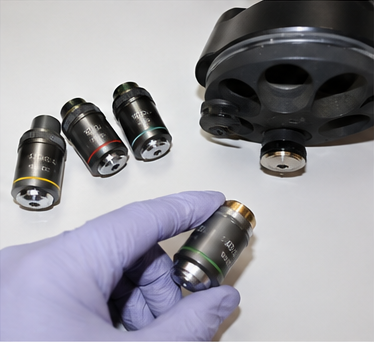
Remove the objectives that needs to be adjusted for parfocal distance from the nosepiece. The 4X and 10X objectives do not have a device for adjusting the parfocal distance and cannot be adjusted, so they can be regarded as the reference objectives. Here, the 10X objective is selected as the reference objective. Keep the 10X objective in place and do not remove it.
2. Remove the Cover
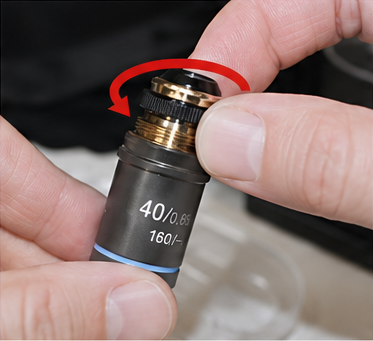
Rotate the threaded part counterclockwise to remove the cover of the objective. It is usually quite easy to unscrew. If you remove the outer covers of multiple objectives at the same time, be sure to remember which cover goes with each objective to avoid confusion.
3. Adjust the Ring
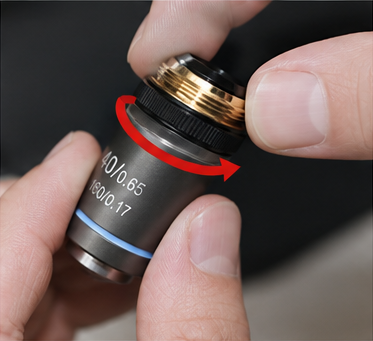
Find the adjustment ring that can adjust the focus. First, try rotating the ring. If it can be rotated, then adjustment can be made directly. If it cannot be rotated, it might be that this objective is fixed with optical glue. In this case, the glue needs to be removed before adjustment.
4. Remove the Glue
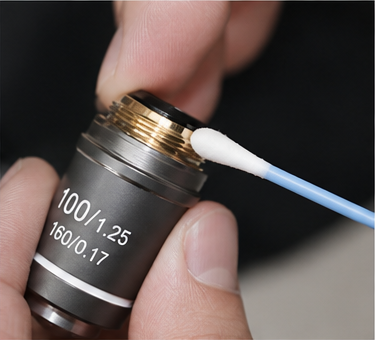
Carefully locate the position of the glue that fixed the adjustment ring. Usually, there is only a single drop of glue. Use a cotton swab moistened with acetone and gently apply it to the glue spot. Carefully remove the glue. Rotate the adjustment ring back and forth until it can be rotated freely.
5. Install the Objectives back into the Nosepiece
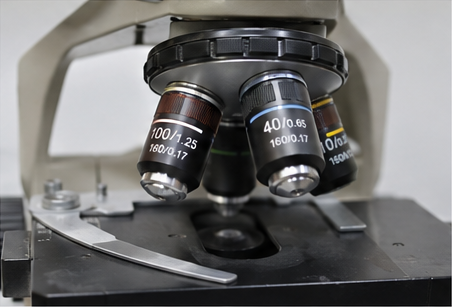
Keep the objectives without the outer cover and install them to the nosepiece. Pay attention to installing it in the order of increasing magnification according to the position of the 10X objective. Then, rotate the nosepiece to the 10X objective. Use the focusing knob to focus the sample with 10X objective. You can choose a micrometer as the sample. Focus the sample until get a clear view.
6. Test the Objectives
Switch the objectives in ascending order of magnification from 10X. Adjust the adjustment ring on the objective to focus the objective onto the sample to show clear image, rather than using the focusing knob. Be very careful and slow when adjusting the ring, as it is very sensitive. After adjusting one objective, switch to the next one in ascending order of magnification for further adjustment. Be cautious when adjusting the ring to avoid over-adjustment that may cause the lens to lose focus or damage the lens due to contact with the sample or stage.
7. Fix the Adjustment Ring with Glue
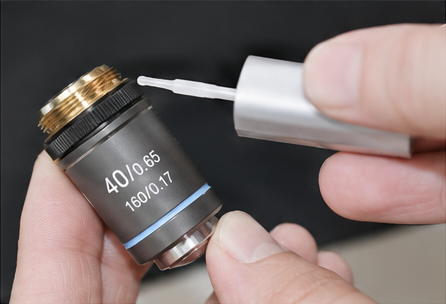
To prevent the adjustment ring from moving position due to vibration or frequent use, you can use optical glue to fix it. If there is no optical glue, you can use transparent nail polish as a substitute. Drop a drop of it at the position between the adjustment ring and the objective body. If you want to avoid the adjustment ring moving during the movement of the objective, you can apply the glue when the objective is on the nosepiece. That is, after adjusting the focus properly, do not remove the objectives from the nosepiece. Wait until the glue is completely dry before reinstalling the objective outer cover.
Following these steps, the adjustment of the parfocal distance of the objectives is completed. Using appropriate calibration tools and conducting the adjustment under the normal temperature and humidity conditions of the microscope’s daily use can enhance the parfocality of the objectives. During daily use, it is important for keeping the parfocality of the microscope to follow standard operating procedures and perform regular maintenance.
The microscope with good parfocality can maintain a relatively stable focus position of samples when switching objectives of different magnifications. There is no need for significant focusing adjustments, which significantly reduces the time required for focusing operations. The operation is convenient and the efficiency is improved.